Image Generation

Create unique visuals from text prompts using SDXL/Flux models. Ideal for designers needing rapid concept visualization.

Flux with DyPE for Native 4K+ Image Generation

Flux with DyPE for Native 4K+ Image Generation

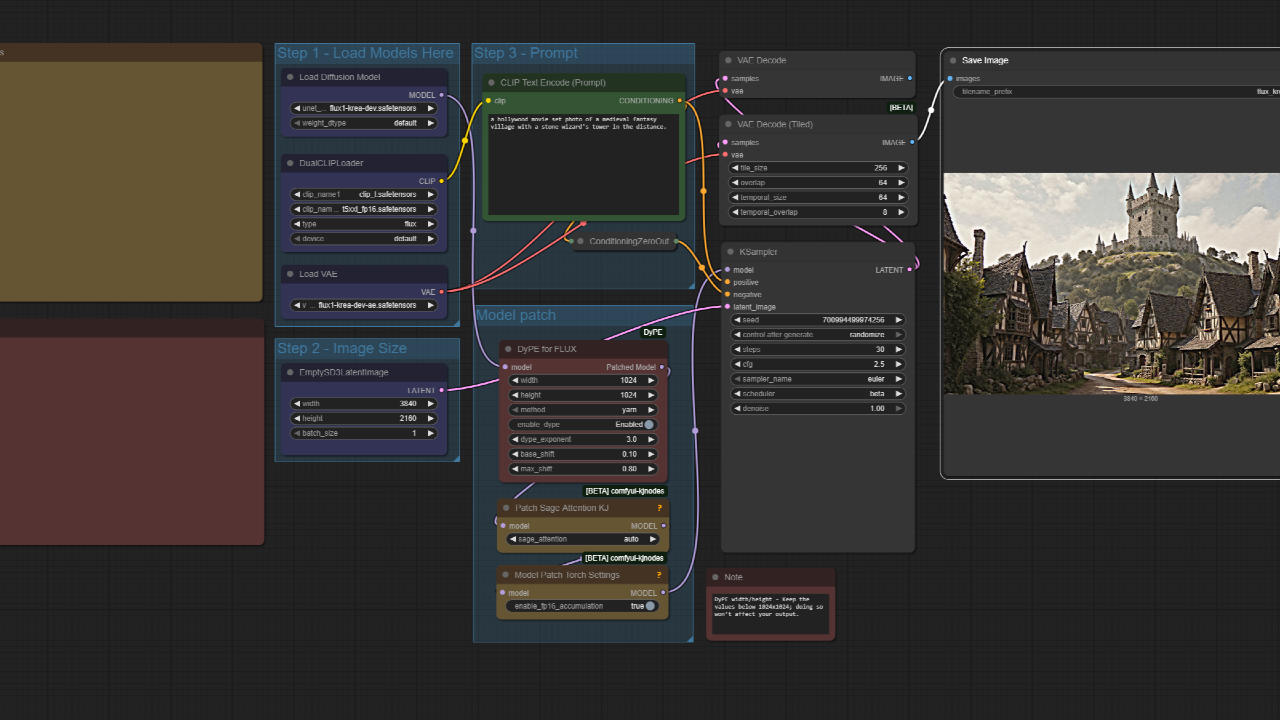
ComfyUI Workflow: Flux with DyPE for Native 4K Image Generation This ComfyUI workflow utilizes the DyPE node to **generate artifact-free, high-resolution images natively**, specifically designed for FLUX models. It allows for the creation of crisp 4K and higher resolution outputs by directly patching the UNet, ensuring superior quality. **What makes Flux with DyPE special** - **Native 4K+ output**: Achieve resolutions of 4K and beyond without relying on traditional upscaling methods. - **Optimized for FLUX models**: Engineered to work seamlessly with FLUX models, enhancing their generation capabilities. - **Direct UNet patching**: DyPE directly patches the UNet for improved image fidelity and stability at high resolutions. - **Dynamic positioning control**: The `enable_dype` toggle offers advanced control over element placement and composition within the high-resolution canvas. **How it works** - **DyPE node integration**: The core DyPE node is integrated into your workflow, managing the high-resolution generation process. - **Parameter tuning**: Fine-tune the `dype_exponent` (2.0 is ideal for 4K+) and select a `method` (yarn recommended) to guide the generation. - **Seamless KSampler connection**: The DyPE node's `MODEL` output directly feeds into your `KSampler` node for integrated high-resolution inference. **Quick start in ComfyUI** - **Set matching resolutions**: Adjust the `width` and `height` parameters on the DyPE node to correspond with the resolution in your `Empty Latent Image` node. - **Configure DyPE parameters**: Select your preferred `method` (yarn is a good starting point), enable or disable `dynamic positioning` using the `enable_dype` toggle, and set `dype_exponent` to 2.0 for 4K output. - **Connect and generate**: Connect the `MODEL` output from the DyPE node to your `KSampler` node's input, then start your workflow. **Recommended settings** - **DyPE exponent**: A value of 2.0 is recommended for robust 4K and higher resolution outputs. - **Generation method**: The 'yarn' method often yields optimal results for high-resolution image generation. - **Initial resolution guidelines**: Keep `width` and `height` parameters below 1024x1024 unless you are using the most current, bug-fixed version of DyPE. **Pro tips** - **Experiment with values**: Adjust `dype_exponent` and `method` to find the best quality for your specific resolution targets and image content. - **FLUX model focus**: Remember that DyPE is specifically designed for FLUX models and only patches the UNet, ensuring focused enhancement. **Why use this workflow** - **Superior image quality**: Generate stunning, artifact-free images at native high resolutions. - **Efficient high-res output**: Streamline your workflow for 4K+ outputs without complex post-processing steps. - **Dedicated FLUX enhancement**: Leverage a tool specifically built to maximize the potential of FLUX models for detailed imagery. **Conclusion** The Flux with DyPE workflow enables ComfyUI users to achieve **native 4K+ image generation** with FLUX models, providing artifact-free, high-fidelity outputs through direct UNet patching and configurable parameters.
Text to Image
Screenshot of the ComfyUI  workflow Wan2.2: Ultimate Text To Image (fast render, cinematic quality)

Wan2.2: Ultimate Text To Image (fast render, cinematic quality)

ComfyUI Workflow: Wan2.2: Ultimate Text To Image (fast render, cinematic quality) This ComfyUI workflow harnesses the robust capabilities of WAN 2.2, a system known for realistic video generation, to create high-quality static images. It produces a batch of images from a given text prompt, utilizing the same models and methods employed for WAN 2.2 videos. The result is crisp, prompt-following, and highly realistic images. What makes Wan2.2 special - **Cinematic realism**: Generates images with a realistic aesthetic, trained on real TV and movie footage for an authentic look. - **Prompt adherence**: Creates images that accurately follow the provided text descriptions. - **Batch generation**: Efficiently produces multiple images in a single processing run. - **Authentic visual quality**: Avoids the "over-filtered" appearance often associated with social media-trained models. - **Fast rendering**: Delivers quick image outputs while maintaining high visual fidelity. How it works - The workflow applies the foundational models and methods of WAN 2.2 video generation to the task of creating still images. - It interprets a text prompt to synthesize and render a collection of images. Why use this workflow - Achieve exceptionally realistic and film-like image outputs. - Generate visuals that precisely match your textual creative brief. - Rapidly produce multiple image variations or options for any concept. - Benefit from a training foundation that prioritizes genuine visual representation.

Text to Image
Screenshot of the ComfyUI Copilot AI assistant. This custom node helps you build workflows by explaining functions and recommending the next logical nodes to add to your canvas.

SD1.5: Anime-style LoRA

ComfyUI Workflow: SD1.5 Anime-style LoRA This ComfyUI workflow lets you **transform everyday photos into stunning anime-style images** inspired by the whimsical and detailed art of Hayao Miyazaki. It helps users maintain the core essence of their original photographs while infusing them with enchanting anime qualities. The process is designed to be straightforward and accessible, with outdoor photos taken in bright environments often yielding the most vibrant results. What makes this workflow special - **Miyazaki-inspired style**: Infuse your photos with the unique characteristics and whimsical details of Hayao Miyazaki's art. - **Original essence preserved**: Maintain the core details of your photograph while applying a distinct anime aesthetic. - **Optimal vibrancy**: Achieves more vibrant and aesthetically pleasing outcomes when using bright outdoor photos. - **User-friendly process**: Designed for accessibility, allowing even beginners to easily transform images without extensive technical knowledge. How it works - **Image selection**: Choose a clear, high-quality photo you wish to transform. - **Preparation**: Ensure the photo captures interesting subjects like landscapes, animals, or people. - **Upload image**: Provide your prepared photo to the workflow. - **Anime style selection**: Specify the application of a Hayao Miyazaki-inspired anime style. - **Processing**: The workflow uses advanced algorithms to reinterpret the image with anime qualities. - **Review output**: Examine the resulting anime-style image. - **Adjustments (if needed)**: Refine the image or processing parameters if the output does not meet expectations. - **Export and share**: Save your final anime-style image for use or display. Why use this workflow - **Effortless artistic transformation**: Quickly convert ordinary photos into captivating anime art. - **Accessible creative tool**: Generate unique stylized images without requiring deep technical expertise. - **Visually rich output**: Produce vibrant and aesthetically pleasing anime-style images from suitable source material. Use cases - **Personal galleries**: Transform your favorite photos into unique anime artworks. - **Creative projects**: Generate stylized images for stories, designs, or digital art. - **Social media sharing**: Share distinct anime-inspired versions of your everyday moments. Recommended tips - **Source image quality**: Begin with clear, high-quality photos for the best results. - **Optimal lighting**: Bright outdoor images with vibrant colors consistently enhance the transformation. - **Engaging subjects**: Photos featuring landscapes, animals, or people tend to create more impactful anime art.

Image Style Transfer
Screenshot of the complete ComfyUI AI influencer workflow. This all-in-one template features a Face Detailer, Refiner, and Upscaler to automatically fix faces and hands for professional-grade images.

Qwen Edit 2509 - Image Edit with multi images input and Multi Lora Loader

ComfyUI Workflow: Qwen Edit 2509 - Image Edit with multi images input and Multi Lora Loader Qwen Edit 2509 is a ComfyUI workflow designed for efficient image editing, allowing you to process multiple images and apply various LORAs quickly. It supports a seamless editing process from input to comparison, aiming for high-quality results. What makes Qwen Edit 2509 special - **Multi-image input**: Process several images simultaneously within the workflow. - **Rapid generation**: Achieve edited outputs in just a few seconds, leveraging lighting LORAs. - **Flexible LORA application**: Load and use multiple LORAs, supporting various Qwen image LORAs. - **Integrated comparison**: Easily review changes with an included image comparison slider. - **Optimized sampling**: Inputs are automatically scaled to 1M pixels for superior sampling quality. How to use - **Load images**: Place your images into the image loader node. They will automatically scale for optimal sampling. - **Select LORAs**: Optionally choose your desired LORAs. Many Qwen image LORAs from Civitai are compatible. - **Input prompt**: Write your desired prompt. You can save prompts using the Prompt Stasher. - **Sampler settings**: - For lighting LORAs, use default sampler settings. - Without lighting LORAs, set steps between 20 and 50 and CFG around 2.5. - **Adjust shift**: Set the shift value, typically between 1.5 and 3.0. - **Generate and compare**: Run the generation process and use the slider node to view the differences. - **Custom image size**: Connect an empty latent node to the VAE encode for custom dimensions. It is recommended to use dimensions that are multiples of 112 for Qwen models. Recommended settings - **Image resolution**: Input images are scaled to 1M pixels for consistent quality. - **LORA compatibility**: While most Qwen image LORAs should work, some may not be compatible. - **Sampler steps**: Use 20-50 steps when not using lighting LORAs for balanced speed and quality. - **CFG scale**: A CFG of approximately 2.5 is suggested for non-lighting LORA use. - **Shift value**: A range of 1.5 to 3.0 generally yields good results for image adjustments. Why use this workflow - **Speed and efficiency**: Quickly edit multiple images with fast generation times. - **High-quality output**: Automatic image scaling and optimized settings contribute to enhanced output quality. - **Versatile LORA support**: Experiment with various LORAs to achieve diverse editing styles. - **Streamlined process**: From loading images to comparing results, the workflow offers a straightforward editing experience.

Inpainting
Screenshot of the free ComfyUI workflow for AI clothes removal and editing. It uses the Grounding DINO model to precisely identify and remove specific clothing items based on a text description.

OmniGen2: Text2Image

ComfyUI Workflow: OmniGen2: Text2Image OmniGen2 is a powerful and efficient multimodal generative model for ComfyUI. It features a dual-path Transformer architecture with independent text and image models, totaling 7B parameters (3B text, 4B image) for specialized optimization and parameter decoupling. What makes OmniGen2 special - **High-fidelity image generation**: Create stunning images from text prompts. - **Instruction-guided image editing**: Perform complex, instruction-based image modifications with state-of-the-art performance among open-source models. - **Contextual visual output**: Generate novel and coherent images by flexibly combining diverse inputs like people, reference objects, and scenes. - **Visual understanding**: Inherits robust image content interpretation from the Qwen-VL-2.5 base model. - **In-image text generation**: Capable of producing clear and legible text content within images. How it works - **Dual-path architecture**: Utilizes a Qwen 2.5 VL (3B) text encoder and an independent diffusion Transformer (4B). - **Omni-RoPE position encoding**: Supports multi-image spatial positioning and differentiates identities effectively. - **Parameter decoupling**: Prevents text generation tasks from negatively impacting image quality. - **Unified task support**: A single architecture handles various image generation tasks, including complex text and image understanding. - **Controllable output**: Provides precise control over image generation and editing processes. - **Detail preservation**: Ensures excellent detail in the final visual outputs. Quick start in ComfyUI - **Inputs**: Text prompts for generation, and optionally instructions for editing. - **Load workflow**: Import the OmniGen2 ComfyUI graph. - **Generate**: Run the workflow to create images or apply edits based on your prompts. Recommended settings - **Machine**: A Large-PRO setup is recommended for optimal performance. Why use this workflow - **Versatile capabilities**: Combines powerful text-to-image generation, advanced editing, and context-aware scene creation. - **Optimized performance**: Benefits from specialized, decoupled text and image models for efficiency and quality. - **High-quality results**: Delivers high-fidelity images with exceptional detail and the ability to generate clear text within images. - **Leading editing features**: Offers precise, instruction-based image modifications comparable to top open-source models. Use cases - **Creative design**: Rapidly generate visual concepts and artwork from textual descriptions. - **Professional image editing**: Apply complex, targeted modifications to images using natural language instructions. - **Scene composition**: Build intricate visual scenes by integrating various contextual elements. - **AI art exploration**: Leverage a cutting-edge multimodal model for diverse generative tasks. Pro tips - Craft detailed and specific text prompts to guide image generation effectively. - Experiment with multi-modal inputs to leverage the context generation capabilities. Conclusion OmniGen2 offers a **unified, efficient, and powerful multimodal generative model** in ComfyUI. It excels at high-fidelity text-to-image generation, instruction-guided editing, and context-aware visual output, providing excellent detail and controllable results.

Text to Image
Screenshot of the free ComfyUI workflow for OmniGen2. This multimodal AI enables advanced, instruction-based image editing, letting you use complex text commands for precise control over your creations.

OmniGen2: Image Edit

ComfyUI Workflow: OmniGen2 for Unified Multimodal Generation OmniGen2 is a ComfyUI workflow that utilizes a powerful and efficient unified multimodal generative model. With a total parameter size of about 7B (3B for text, 4B for image), it features an innovative dual-path Transformer architecture with independent text autoregressive and image diffusion models. This design allows for parameter decoupling and specialized optimization, supporting a wide range of visual tasks from understanding to generation and editing. What makes OmniGen2 special - **Unified multimodal capabilities**: Seamlessly integrates visual understanding, high-fidelity text-to-image generation, and advanced instruction-guided image editing. - **Advanced image editing**: Performs complex, instruction-based image modifications, achieving strong performance among open source models. - **Contextual generation**: Processes and combines diverse inputs including people, reference objects, and scenes to produce novel and coherent visual outputs. - **High visual quality**: Creates beautiful images with excellent detail preservation. - **Integrated text generation**: Capable of generating clear and legible text content within images. How it works - **Dual-path architecture**: Leverages a Qwen 2.5 VL (3B) text encoder alongside an independent diffusion Transformer (4B). - **Parameter decoupling**: Ensures that text generation and image generation are optimized independently, avoiding negative interactions. - **Omni-RoPE position encoding**: Supports multi-image spatial positioning and differentiation of identities. - **Comprehensive understanding**: Facilitates complex interpretation of both text prompts and existing image content. Why use this workflow - **Versatility**: A single unified architecture supports a broad spectrum of image generation and editing tasks. - **Optimized performance**: Independent model components lead to specialized optimization and improved output quality. - **Precise control**: Offers fine-grained control over image generation and editing through detailed instructions. - **Leading capabilities**: Delivers state-of-the-art results for instruction-guided image editing within the open-source domain. Use cases - **Creative content creation**: Generate detailed and coherent images from textual descriptions. - **Advanced visual editing**: Modify images with specific instructions, enabling complex alterations. - **Scene composition**: Combine various elements to construct new visual scenes and narratives. - **Graphical design**: Create images that require integrated and clear text elements.

Inpainting
Screenshot of the free ComfyUI workflow featuring the HiDream-E1 super-resolution model. It's optimized to upscale and enhance anime and stylized art, transforming low-res images into HD masterpieces.

InstaLoRAm: Your Virtual Influencer Generator

ComfyUI Workflow: InstaLoRAm - Your Virtual Influencer Generator This workflow uses QwenEdit, Loras, and SDXL upscale to create an infinite number of pictures of your input image. From one single image and as many prompts as you desire, you can generate your subject in any situation and clothing imagined. The results can be used to train a LoRA or directly populate a virtual social media feed. **What InstaLoRAm Achieves** - **Versatile Image Generation**: Transforms a single source image into countless new visual scenarios. - **Creative Control**: Guides image generation with multiple text prompts for diverse situations and attire. - **High-Quality Outputs**: Leverages SDXL upscale for detailed and refined images. **How It Works** - **Single Image Input**: Begin with one core image of your subject. - **Prompt-Driven Creation**: Supply various prompts to dictate desired contexts, poses, and clothing. - **Advanced AI Integration**: Utilizes QwenEdit and Loras to intelligently modify and render new images based on your prompts. **Use Cases** - **Virtual Social Media**: Populate a virtual influencer's feed with endless unique content. - **LoRA Dataset Generation**: Create a rich dataset for training custom LoRA models. - **Character Concepting**: Rapidly explore different looks and environments for a specific character. **Quick Start in ComfyUI** - **Load the Workflow**: Open the InstaLoRAm graph in ComfyUI. - **Connect Input**: Provide your chosen source image. - **Set Prompts**: Enter your descriptive prompts for desired outcomes. - **Generate Images**: Run the workflow to produce a series of unique visual outputs.

Text to Image
Screenshot of the free ComfyUI workflow for ByteDance USO. This powerful model unifies style and character transfer, using the FLUX.1 architecture to maintain subject identity and apply artistic styles.

HiDream E1.1: Image Edit

ComfyUI Workflow: HiDream E1.1 for Simple Image Super-Resolution HiDream E1.1 is a ComfyUI workflow designed for **super-resolution tasks, enhancing image quality and detail** from low-resolution inputs. This workflow offers a straightforward and efficient method to generate high-definition outputs without complex configurations. What makes HiDream E1.1 special - **High-definition output**: Directly generates improved images from low-resolution sources. - **User-friendly**: Simple workflow suitable for all users, requiring minimal setup. - **Artistic style preservation**: Effectively restores details, reduces noise, and retains the original artistic style, particularly strong for anime and illustrations. - **Flexible integration**: Supports combination with other ComfyUI nodes for complex image processing workflows. How it works - **Load input**: Users load the low-resolution image using the "LoadImage" node. - **Model inference**: The image connects to the "HiDream-E1" model node for super-resolution processing. - **Save output**: The processed high-definition image is then saved via the "SaveImage" node. Quick start in ComfyUI - **Inputs**: A low-resolution image for enhancement. - **Load workflow**: Open the HiDream E1.1 ComfyUI graph. - **Connect nodes**: Link your `LoadImage` node to the `HiDream-E1` model, then connect the model's output to a `SaveImage` node. - **Generate**: Run the inference to produce your enhanced, high-definition image. Why use this workflow? - **Streamlined enhancement**: Provides a powerful solution for image enhancement without requiring advanced technical knowledge. - **Quality restoration**: Ideal for improving clarity and detail in images, especially for stylized content. - **Creator support**: Offers a robust tool for creators needing to upscale and refine their visual assets. Use cases - **Anime and illustration enhancement**: Improve resolution and detail while maintaining the unique artistic characteristics. - **General image upscaling**: Turn low-resolution photos or graphics into higher-quality versions. - **Integration into larger pipelines**: Combine with other nodes for advanced creative or production workflows. References - [https://github.com/HiDream-ai/HiDream-E1](https://github.com/HiDream-ai/HiDream-E1) - [https://huggingface.co/HiDream-ai/HiDream-E1-1](https://huggingface.co/HiDream-ai/HiDream-E1-1)

Inpainting
Screenshot of the free ComfyUI workflow for OmniGen2, an advanced multimodal model. It excels at text-to-image, instruction-guided editing, and generating clear, legible text within images.

Ghibli Style Video Generation

ComfyUI Workflow: Ghibli Style Video Generation This ComfyUI workflow offers a unique path for creating Ghibli-style video content. It transforms a single input picture into a dreamy Ghibli-style image and then animates that image into a dynamic video. Built with the EasyControl and wan nodes, this workflow facilitates a seamless transition from static visuals to animated narratives. What makes this workflow special - **Single image input**: Start with just one picture and transform it into a beautiful Ghibli-style image using the EasyControl node. - **Dynamic video output**: Convert the generated Ghibli-style pictures into captivating videos through the wan node. - **Seamless creation**: Achieve a complete workflow from a static image to a dynamic video, offering new possibilities for creative expression. How it works - **Hugging Face token acquisition**: Secure an hf_token for accessing necessary models. - **Ghibli image creation**: Upload a source image and input a text prompt. Enable the 'Ghibli' feature to generate a Ghibli-style picture. Adjust image resolution (height and width) as needed. An optional `load_8bit` function can reduce graphics card memory usage, though it may extend image generation time. - **Ghibli video generation**: Activate the 'video' feature. Input the previously generated Ghibli-style pictures and a text prompt. Control video resolution using 'generation_width' and 'generation_height' parameters. Customize video length by adjusting 'frame_rate' or 'num_frames' within the WanVideo Empty Embeds node. - **Performance options**: - `WanVideo TeaCache`: Accelerates video generation but may reduce video quality. - `WanVideo Enhance-A-Video`: Improves video quality, which can increase video generation time. Recommended machine - Ultra-PRO Workflow details - **APP**: ComfyUI (v0.3.27) - **Models**: 1 - **Extensions**: 11 - **File space**: 44 GB

Image Style Transfer
Screenshot of the free ComfyUI workflow for the FLUX.1-Krea-dev text-to-image model. This next-gen tool creates realistic, aesthetically unique images, avoiding the generic 'AI look' and preserving natural detail.

FLUX & Krea: Text2Image

ComfyUI Workflow: FLUX & Krea Text2Image Generation This FLUX & Krea workflow integrates the FLUX.1-Krea-dev model, a collaboration between Black Forest Labs and Krea AI, for generating high-quality images from text descriptions directly within ComfyUI. It is built on a 12-billion-parameter rectified flow transformer architecture to deliver realistic and aesthetically pleasing visual outputs. What makes FLUX & Krea special - **Unique Aesthetic Style**: Generates images with a distinct aesthetic, avoiding common "AI-like" visual characteristics. - **Natural Detail Preservation**: Maintains natural details without over-highlighting. - **Superior Realism**: Offers exceptional image quality and realism. - **Full FLUX.1 Compatibility**: Designed with an architecture fully compatible with FLUX.1 [dev]. - **Optimized for ComfyUI**: Tailored for seamless integration into creative workflows. How it works - **Rectified Flow Transformer**: Leverages a 12-billion-parameter rectified flow transformer for efficient and high-fidelity image synthesis. - **Text-to-Image Generation**: Transforms detailed text prompts into visually rich images. - **VRAM Management**: Defaults to `fp8_e4m3fn_fast` for broader compatibility, with an option for `default` `weight_dtype` for users with higher VRAM (e.g., RTX 4090 24GB) to achieve better quality. Quick start in ComfyUI - **Load Workflow**: Open the FLUX & Krea Text2Image graph in ComfyUI. - **Step 1: Input the Prompt**: Enter your desired text description into the prompt field. - **Step 2: Set the Canvas Resolution**: Adjust the image dimensions to your preference. - **Step 3: Get Image**: Run the workflow to generate your image based on the input. Recommended settings - **VRAM**: The original model is approximately 23GB. For optimal quality, an RTX 4090 with 24GB VRAM is recommended, allowing you to set `weight_dtype` to `default`. - **Weight Data Type**: For lower VRAM setups, keep `weight_dtype` set to `fp8_e4m3fn_fast`. - **Machine Type**: A 'Large-Pro' machine is recommended for smooth operation. Why use this workflow - **High-Quality Outputs**: Generate visually appealing and realistic images from text. - **Efficient Creation**: Streamlines the process of turning ideas into visuals. - **Artistic Control**: Produce images with a unique aesthetic that avoids generic AI looks. Use cases - **Concept Art Generation**: Rapidly create visual concepts for projects. - **Creative Content Production**: Generate unique images for marketing, design, or personal use. - **Visual Storytelling**: Bring narratives to life with custom-generated imagery. Pro tips - **Prompt Detail**: Use descriptive and specific prompts to guide the model to your desired output. - **Resolution Experimentation**: Try different canvas resolutions to see their impact on image detail and composition. - **VRAM Awareness**: Monitor your VRAM usage, and adjust `weight_dtype` if you encounter memory issues. - **Community Resources**: For very low VRAM systems, consider waiting for community-developed fp8 or GGUF versions of the model.

Text to Image
Screenshot of the free ComfyUI workflow for cinematic text-to-video. It uses the WAN 2.2 model with an intelligent prompt extension and enhanced color grading for high-quality AI video generation.

FLUX & ByteDance-USO: Single Img2Img

ComfyUI Workflow: FLUX & ByteDance-USO: Single Img2Img This ComfyUI workflow integrates the USO (Unified Style-Subject Optimized) model, developed by Bytedance. Built on the FLUX.1-dev architecture, USO unifies style-driven and subject-driven image generation tasks within a single framework. It is designed to achieve both high style similarity and consistent subject identity in generated images. **Key Capabilities** - **Subject-driven generation**: Places subjects into new scenes while consistently maintaining their identity. - **Style-driven generation**: Applies artistic styles from reference images to new content. - **Combined mode**: Utilizes both subject and style references for integrated image transformations. **How it Works** USO addresses the challenge of unifying style and subject generation by focusing on the disentanglement and re-composition of "content" and "style". - **Decoupled learning**: The model employs a learning strategy that separates the understanding of style and subject characteristics. - **Style Reward Learning (SRL)**: A specialized learning paradigm further refines the model's performance in style application. - **Disentangled learning scheme**: This involves two objectives to achieve content-style separation: - **Style-alignment training**: Aligns and learns style features effectively. - **Content-style disentanglement training**: Separates content information from stylistic elements for flexible re-composition. - **Large-scale triplet dataset**: The model is trained on a comprehensive dataset consisting of content images, style images, and their stylized counterparts. **Why use this workflow** - **Unified solution**: Provides a single framework for tasks traditionally treated as separate, bridging the gap between style and subject generation. - **Consistent results**: Ensures both stylistic resemblance and subject fidelity in generated outputs. - **Broad application**: Suitable for diverse creative image generation needs, from character placement to artistic stylization. **Further Information** - [USO Project Page](https://bytedance.github.io/USO/) - [USO GitHub Repository](https://github.com/bytedance/USO)

Image to Image
Screenshot of the free ComfyUI workflow for creating AI talking head videos. It uses the Infinite Talking model to animate a static image with an audio file, producing realistic, unlimited-length lip-sync videos.

Consistent Character Generator for AI Influencer Creation

ComfyUI Workflow: Consistent Character Generator for AI Influencer Creation This ComfyUI workflow creates consistent realistic characters from multiple angles. It integrates DeepSeek-JanusPro for accurate prompt generation through image inversion, utilizes the PuLID-Flux model to restore over 90% of facial features, employs OpenPose for precise skeleton and posture control, and leverages the Flux model's semantic understanding to optimize detail consistency. This advanced setup is well-suited for developing consistent character representations, including applications for AI influencers and AI models, ensuring precise and realistic outcomes. What makes this workflow special - **Consistent realistic characters**: Generates characters that maintain appearance and details across various angles and poses. - **Accurate prompt generation**: DeepSeek-JanusPro performs image inversion to produce precise and contextually relevant prompt words. - **High-fidelity facial restoration**: The PuLID-Flux model restores over 90% of facial features, ensuring high-quality and consistent facial details. - **Precise posture control**: OpenPose provides skeleton control to fix and align character poses for natural movement. - **Optimized detail consistency**: The Flux model enhances semantic understanding to ensure fine details like facial features, clothing, and posture remain consistent across outputs. - **Ideal for AI influencers and models**: Specifically designed to meet the demands of creating professional-grade virtual personas. How it works - **DeepSeek-JanusPro**: Processes input images to generate detailed and accurate text prompts that guide the character generation process. - **PuLID-Flux Model**: Focuses on the face, restoring and maintaining facial feature consistency and detail, crucial for identity preservation. - **OpenPose Skeleton Control**: Interprets and applies desired body poses, ensuring the character's posture and movement are natural and consistent. - **Flux Model**: Works at a holistic level, improving the overall semantic understanding and consistency of details across the entire character and scene. How to use this workflow - **Workflow Master Switch**: Easily enable or disable features like the upscaler or DeepSeek integration to customize processing based on your needs. - **Step 1: Upload Pictures**: - **AI Influencer Image**: Upload a desired character image in the "deepseek" group or disable "Enable deepseek" and provide a prompt. - **Portrait Image**: Upload a portrait image in the "pulid" group for facial detail extraction. - **Pose Image**: Provide an image to define the character's posture and movement. - **Step 2: FaceDetailer and Expression Editor**: - **Facial Refinement**: Use FaceDetailer to enhance and polish facial details. - **Expression Adjustment**: Modify facial expressions using the Expression Editor for desired moods or actions, such as eye and mouth movements or head turns. - **Step 3: SUPIR Upscale**: Optionally upload the image to the SUPIR Upscaler for enhanced resolution and detail, producing higher-quality final outputs. - **Consistent Character Generation Tips**: Plan character style, movements, and key details in advance to streamline the workflow and reduce adjustments, ensuring efficient and high-quality results. Use cases - **AI Influencers**: Create consistent and realistic virtual influencers for social media, maintaining cohesive personalities across content. - **AI Models for Marketing and Branding**: Develop virtual models for advertising, ensuring consistent appearance and posture for branding campaigns. - **Game Character Design**: Design and refine high-quality, consistent characters for video games and animation projects, including faces, expressions, and movements. - **Film and Animation Pre-Production**: Generate character concepts with detailed facial features and consistent expressions across multiple scenes for film or animation. - **AI-Powered Virtual Assistants**: Develop consistent character identities for virtual assistants or chatbots, aligning appearance and expressions with their purpose.

Image to Image

Filters